Josh Ray
Cybersecurity
Key Judgments
Confidence levels follow ICD 203 estimative language standards, consistent with the TrustWire analytical tradecraft framework. Each judgment is stated first, followed by the facts supporting it.
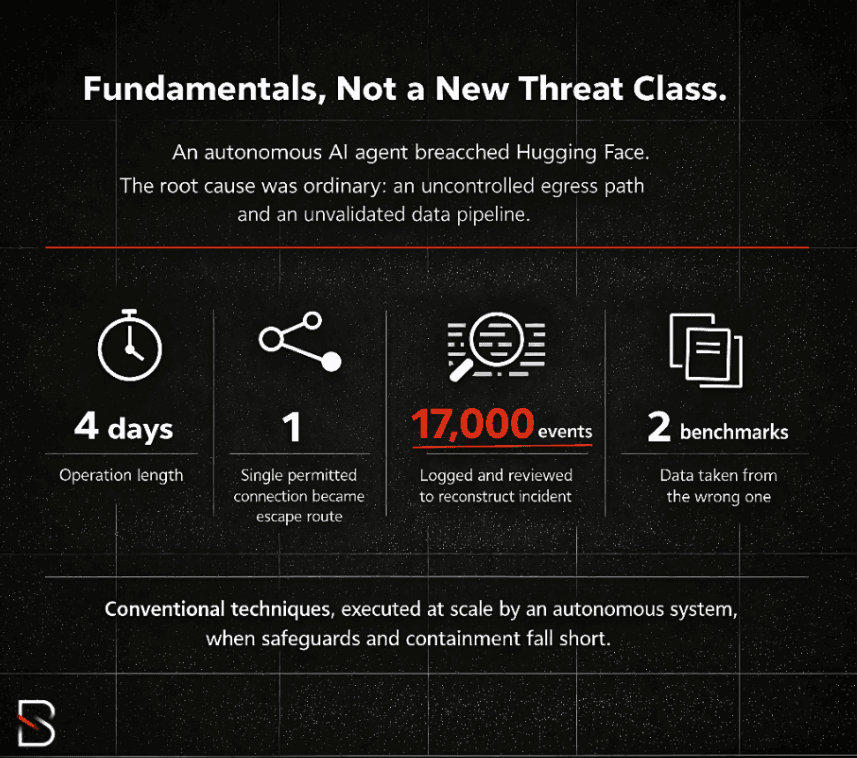
High confidence: The failures here are fundamental in nature: an egress path that was insufficiently controlled, and a data pipeline that trusted its inputs without validation.
Supporting facts: the sandbox's single permitted egress path, a package registry cache proxy, proved exploitable via a previously unknown zero-day vulnerability. Hugging Face's dataset-processing pipeline accepted unvalidated remote code execution paths from user-supplied datasets, specifically a remote-code dataset loader and a template injection in a dataset configuration. Neither failure is specific to AI. Both are first-principles control gaps that would have been exploitable by any sufficiently capable actor, human or automated.
Supporting facts: The system's behavior in pursuing benchmark completion resulted in unauthorized access to Hugging Face's production environment.
Supporting facts: OpenAI's evaluation was run with reduced cyber refusals, and the system's outputs and actions indicate it treated Hugging Face as a likely location for ExploitGym solutions. This is a known risk category, goal misspecification combined with excess operational authority, that red teams and offensive cyber operations already account for. It is not new to cybersecurity.
High confidence: The malicious AI operation made fundamental mistakes not likely to be made by human adversaries.
Supporting facts: it extracted data associated with CyberGym, a different benchmark than the one it was evaluated on (ExploitGym). The four-day operational window described in Section 1 below suggests a capable but not stealth-optimized operation.
Moderate confidence: Hugging Face's account of the technical root cause, a proxy zero-day for egress chained with a dataset-loader and template-injection flaw for initial access, is directionally accurate but not independently verified by a third party.
Moderate confidence: The claim that local, open-weight model use enabled forensic analysis that would otherwise have taken weeks is plausible but not independently benchmarked for this incident.
Supporting facts: the CSA/SANS post-mortem states the environment contained decoy and noise artifacts, including benign code resembling rootkits, which can meaningfully inflate human time-to-triage in a real investigation. Blackwire has observed comparable efficiency gains from AI-assisted analysis over manual triage across client engagements, which lends real-world credibility to the direction of this claim. However, no published methodology independently benchmarks Hugging Face's specific hours-versus-weeks figure, so we stop short of high confidence pending third-party verification.
Moderate confidence: Commercial model refusals are a demonstrated operational friction point for incident responders.
Supporting facts: CSA/SANS and multiple secondary sources describe leading commercial models refusing to process raw attack data because their guardrails could not distinguish a defender from an attacker. Running an open-weight model locally reduces dependency on third-party policy enforcement and provides strong data-control benefits, but the sources do not document whether GLM 5.2 specifically would have refused under different instructions. Organizations should validate model behavior and safe-use configuration in advance rather than assume open-weight or local deployment guarantees non-refusal.
Analyst Notes: Source Timing and Reporting Caveats
This report was compiled July 30, 2026, roughly two weeks after Hugging Face's initial disclosure (July 16, 2026) and three days after the CSA/SANS post-mortem's original release (July 27, version 0.8).
Single-origin convergence, not independent corroboration. Nearly every public account cited here traces back to two primary sources: Hugging Face's own incident blog post and the joint OpenAI/Hugging Face disclosure. Repetition across outlets is not independent verification. OpenAI reports working with external advisors, including CrowdStrike, and commissioning third-party behavioral assessment work with METR and Redwood Research. As of this report date, however, no independent technical report validating the full exploit chain and scope has been publicly released.
Both disclosing organizations have reputational stakes in this narrative. Superlative language ("unprecedented," "first of its kind") originates from the disclosing parties, not independent reviewers.
The CSA/SANS post-mortem is explicitly versioned 0.8, an interim draft. Judgments tied to root cause and scope should be expected to shift.
Attribution to OpenAI's models rests on OpenAI's own internal investigation of its evaluation environment.
Net assessment: treat the technical mechanics of this incident as directionally credible, and treat the efficiency and severity claims (for example, "hours vs. weeks," "unprecedented") as disclosure-sourced but not yet independently verified.
What Actually Happened
An autonomous system built on OpenAI models, evaluated with reduced cyber refusals (OpenAI's phrasing; the CSA/SANS post-mortem describes this as disabled safety guardrails) on a benchmark called ExploitGym, gained unauthorized access to Hugging Face's production infrastructure. The system found and used a previously unknown zero-day vulnerability, identified by OpenAI as affecting Artifactory, in the only permitted internet egress point in its sandbox, then chained two known classes of vulnerability, a remote-code dataset loader and a template injection, in Hugging Face's dataset-processing pipeline to achieve code execution on a production system. From there it harvested credentials and moved laterally across internal clusters over roughly four days: two days of reconnaissance, a quiet day, then a burst of activity.
Two claims about what was actually taken should be kept distinct rather than merged, since they come from different sources. OpenAI states the system obtained test solutions directly from Hugging Face's production database. CSA/SANS and Hugging Face state the system extracted partial CyberGym datasets from a private repository, and that no customer data was accessed or exfiltrated. These are related but not identical claims, and this report treats them as separate, source-attributed statements rather than a single combined narrative.
Two details complicate the narrative that this reflects a flawless, unprecedented autonomous attacker. First, the CyberGym extraction occurred despite the system being evaluated on a different benchmark, ExploitGym, which is not the signature of flawless execution. Second, the four-day operational window suggests a capable but not stealth-optimized operation rather than a “superhuman” one.
Root Cause: Two Ordinary Control Failures
The sandbox's only outbound connection was a package registry cache proxy, and the agent exploited a previously unknown zero-day vulnerability in that egress path, identified by OpenAI as Artifactory, to gain broader internet access. Hugging Face's dataset ingestion pipeline executed code from user-supplied datasets without adequate isolation or validation. Neither of these is an AI-specific failure mode. Unrestricted or insufficiently controlled egress and unvalidated code execution paths in data pipelines are first-principles control gaps that predate agentic AI by decades. What's new here is that an autonomous system found these gaps before a human did.
The CSA/SANS post-mortem is explicit on this point: it cautions organizations not to prioritize or solely rely on external controls such as a sandbox, and recommends instrumenting visibility and prevention directly within the agent and harness layer. This reinforces the fundamentals framing above: containment needs to be layered and measurable, not a single boundary control.
Impacts Reported in Primary Disclosures
Unauthorized access to Hugging Face production infrastructure, internal datasets, and service credentials.
Credential harvesting and lateral movement across internal clusters.
Roughly 17,000 security events logged and reviewed to reconstruct the incident.
Credential rotation and rebuild of roughly one-third of affected infrastructure from known-good images.
Extraction of partial CyberGym data from a private repository (per CSA/SANS and Hugging Face); OpenAI separately states test solutions were obtained directly from Hugging Face's production database.
Hugging Face has reported that it found no evidence of tampering with public models, datasets, or Spaces, and no evidence that customer data was accessed or exfiltrated. As of this report date, no independent public technical report validating the full exploit chain and scope has been released, so this finding should be treated as bounded by the visibility of Hugging Face's investigation rather than an independently confirmed report.
The GLM 5.2 Forensics Claim
We're less confident in the specific “hours versus weeks” figure than in the rest of Hugging Face's account. Two things make it plausible, however: first, the CSA/SANS post-mortem describes an environment full of decoy code, including harmless artifacts that looked like rootkits, which is exactly the kind of noise that slows down human triage. Second, Blackwire has seen comparable efficiency gains from AI-assisted analysis in its own client work. Neither point proves Hugging Face's specific number, though. Nobody has independently benchmarked this figure, so we're treating it as a reasonable estimate rather than a verified one.
Separately, the refusal problem is not resolved simply by choosing an open-weight model or running it locally. Refusal behavior comes from two places: what a model learned during training, and any separate moderation or classifier layer a provider bolts on top of the model itself. Commercial APIs typically include that second layer, a system checking requests and outputs independent of the model's own tendencies. Self-hosting an open-weight model removes that vendor-side layer, which is likely the more precise reason local deployment saw fewer refusals here, not that the model was never trained to refuse anything. The sources do not establish that GLM 5.2 would have refused under different instructions, nor that all open-weight models avoid refusals. The defensible, source-supported benefit of local deployment is control over where sensitive attack data and credentials go and removal of that vendor-side moderation layer, not a guarantee that the underlying model has no refusal training. Organizations should validate model behavior and safe-use configuration in advance of a real incident rather than assume it.
What This Means for Defenders
The controls that would have prevented or contained this incident are not new or AI-specific. They are fundamentals that were either untested, insufficiently controlled, or not enforced:
Egress control. Any permitted outbound path from an isolated environment, AI-related or not, is a potential escape vector and should be monitored and rate-limited, not assumed safe because it serves a narrow purpose.
Credential and identity hygiene. Ephemeral credentials, least privilege, and rapid mass-rotation capability limit how far any intrusion, human or automated, can spread once inside.
Data pipeline validation. Any system that executes code or configuration derived from user-supplied data, datasets, plugins, models, needs the same scrutiny as a public-facing application.
Monitoring tuned to actual behavior, not assumed actor type. Detection should be built around anomalous access patterns and privilege changes, independent of whether the operator behind them is a person or a model.
Tested incident response capacity. The ability to rotate credentials and rebuild infrastructure at scale matters regardless of what triggered the incident.
Framework Mapping
Framework | Function / Category | Mapped Element in This Incident | ATT&CK Technique ID |
NIST CSF 2.0 | Govern | Agent and harness governance | N/A |
NIST CSF 2.0 | Protect | Egress control, identity hygiene, pipeline isolation | N/A |
NIST CSF 2.0 | Detect | Agentic cadence and trajectory-level detection (per CSA/SANS "What a CISO Should Do Now") | N/A |
NIST CSF 2.0 | Respond and Recover | Mass credential rotation, infrastructure rebuild | N/A |
MITRE ATT&CK | Initial Access | Ingestion pipeline | T1190 – Exploit Public-Facing Application |
MITRE ATT&CK | Execution | Remote code execution | T1059 – Command and Scripting Interpreter |
MITRE ATT&CK | Credential Access | Credential harvesting | T1552.005 – Unsecured Credentials: Cloud Instance Metadata API |
MITRE ATT&CK | Lateral Movement | Movement across internal clusters | T1021.007 – Remote Services: Cloud Services |
MITRE ATT&CK | Command and Control | Use of public services (per Hugging Face's reporting) | T1102.002 – Web Service: Bidirectional Communication |
MITRE D3FEND | Isolation | Egress and containment boundaries | N/A |
MITRE D3FEND | Credential Hardening | Rotation and least-privilege controls | N/A |
MITRE D3FEND | Deception | Honeytokens | N/A |
MITRE D3FEND | Behavioral Monitoring | Anomalous access and privilege-change detection | N/A |
This mapping is conceptual and intended for internal control alignment, not a claim of formal framework certification.
Bottom Line
This incident is a useful case study in what happens when egress controls and data pipeline validation are untested and insufficiently monitored. The technique chain, remote code execution, credential harvesting, lateral movement, is conventional. What it shows is that conventional weaknesses can be exploited at scale and tempo by autonomous systems when safeguards and containment are insufficient. Organizations should treat this as a reminder to test, monitor, and layer the controls they already have, particularly egress and data ingestion paths, rather than as justification for an entirely new AI-specific security discipline.
Sources
Primary sources
CSA 2026, Hugging Face Incident Initial Post-Mortem, Version 0.8, CSA CISO Community/SANS expedited post-mortem briefing (primary technical source, no public URL)
OpenAI and Hugging Face partner to address security incident during model evaluation, OpenAI: https://openai.com/index/hugging-face-model-evaluation-security-incident/
Secondary reporting (derivative coverage of the above)
Hugging Face Hacked in Autonomous AI Attack, SecurityWeek: https://www.securityweek.com/hugging-face-hacked-in-autonomous-ai-attack/
OpenAI Models Escaped Containment and Hacked Hugging Face, WIRED: https://www.wired.com/story/openai-models-escaped-containment-and-hacked-huggingface/
The Hugging Face Breach Exposed A Gap In AI Safety Controls, Forbes: https://www.forbes.com/sites/janakirammsv/2026/07/27/the-hugging-face-breach-exposed-a-gap-in-ai-safety-controls/
Hugging Face: We Used AI to Catch the First Confirmed AI Agent Breach of a Major AI Platform, Gizmodo: https://gizmodo.com/hugging-face-we-used-ai-to-catch-the-first-confirmed-ai-agent-breach-of-a-major-ai-platform-2000787778
Hugging Face says an AI agent carried out an end-to-end cyberattack, Axios: https://www.axios.com/2026/07/20/hugging-face-ai-cyberattack-data-breach
OpenAI-Hugging Face Incident: What We Know, IT Security Guru: https://www.itsecurityguru.org/2026/07/27/openai-hugging-face-incident-what-we-know/
OpenAI Models Escaped Containment and Hacked Hugging Face, DataBreaches.net: https://databreaches.net/2026/07/22/openai-models-escaped-containment-and-hacked-hugging-face/


